
Category Archives: Routine Testing

ASTM D130 Copper Corrosion Testing Provided by Eurofins TestOil
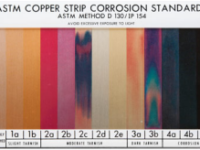
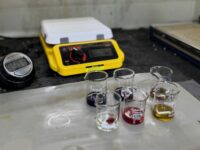
ASTM D130, the Copper Corrosion Test, evaluates the corrosive/tarnishing properties of hydrocarbon-based substances, including fuels, lubricants, and additives, on copper. This test is crucial for assessing fluid compatibility with copper and copper alloy components in equipment. It ensures that fuels meet corrosion standards and that lubricant and hydraulic fluids are safe for use in systems…
Read more

Crackle Test for Industrial Oil: Simple, but a Great First Line Indicator

The routine Crackle Test reveals the presence of free or emulsified water, but not dissolved water, in oil. It typically detects water concentrations of around 500 parts per million (ppm) or higher. However, specific oils exhibit different crackle detection limits. Understanding the specific detection limit for the oil being tested is critical for useful results.…
Read more

Viscosity Testing for Industrial Lubricants

Definitions• Kinematic Viscosity: The measure of a fluid's resistance to flow under the influence of gravity.• Viscosity Index: A dimensionless number that indicates how much a lubricant's viscosity changes with temperature.• Viscosity SUS: Saybolt Universal Viscosity (SUS) is a unit of measurement that quantifies a fluid's kinematic viscosity using a Saybolt viscometer. ViscosityThe single most…
Read more

Testing Server Coolants: The Key to Protecting Both the Equipment and Your Data

Regular maintenance and monitoring of data center coolant are crucial for ensuring optimal performance and longevity of the cooling system. Testing, in particular, should occur regularly for several reasons:• Contaminant Control: Over time, coolants can accumulate contaminants such as particulate matter, biological growth, or metallic particles from corrosion. These contaminants can block cooling passages and…
Read more

Flash Point Testing: 2 Methods Offered By Eurofins TestOil

Flash Point measures the lowest temperature at which a liquid generates sufficient vapor to form a flammable mixture with air near its surface. It assesses the flammability and volatility of fuels, oils, solvents, and other chemical substances. Purposes of Flash Point testing include Quality Control: Companies test the flash points of products to ensure consistency…
Read more

Getting Started with Oil Analysis? Learn How Fewer Oil Changes Deliver ROI.

Interested in getting started with oil analysis? There will never be a better time than now. Eurofins TestOil oil analysis experts routinely save industrial customers both time and money with evidence-based advice on when and when not to change the oil at their plants.             One of the many ROI benefits of professional industrial oil…
Read more